Online guide
Closing the gaps: A global student view on AI and academic integrity
AI is here and students are using it. But the rules are still being written.
Before we can build a future of academic integrity, we need to understand what students think, what they fear, and what they say they need to succeed.
With global, multi-source data that reveals where the disconnects are, we highlight the shared opportunities for institutions to bridge them.
The action gap:
A disconnect between concern and behavior
Despite widespread anxiety about its risks, student adoption is nearly universal - a global trend reflected in data from countries like India, Australia, and the US.²

Who is most concerned about AI?²
Students: 64%
Educators: 50%
Administrators: 41%

But the primary fear about AI is not a point of conflict.
Over-reliance on AI is the #1 concern for students and educators.²
And yet, AI adoption is undeniable:
86%
of students now use AI in their studies.¹

Insight:
High usage in the face of high concern suggests that simply banning AI across the institution is not a viable option. Educators need visibility into how rather than if AI is being used in student work. Solutions like Turnitin Clarity offer the transparency to help educators and institutions move beyond detection to have richer conversations and build a culture of integrity.
The integrity gap:
A mismatch in expectations
For students, integrity is a matter of context and intent. Their ethical standards are often stricter than the policies in place - an opinion matched in countries like Indonesia, Mexico, and Cameroon.³
Who classifies using AI to write an entire assignment as "cheating"?
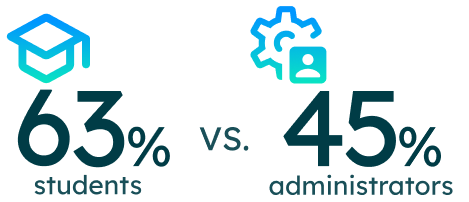
While definitions may differ, there is universal agreement on the scale of the problem:
95%
of students, educators, and administrators agree that AI is currently being misused.²
Insight:
This mismatch creates a wide gray area, leaving students and educators to navigate the rules around AI on their own. This isn't just about detection, but about providing consistent feedback that teaches students how to use AI responsibly and appropriately.
The readiness gap:
Students are looking for more support
Students clearly connect ethical AI use in their studies to the skills required for their future, but the data reveals a major gap between this need and their current reality.
82%
of students say knowing how to use AI is essential for their future.⁴
However:
50%
of students do not feel “AI-ready”.¹
80%
of students expect more guidance from their institution.¹
Insight:
This demand creates a new assessment challenge: how can institutions integrate training for what is now becoming a baseline skill into their curriculum, all while ensuring students are still developing their own critical thinking? The clear next-step for institutions is to protect originality by confidently distinguishing between AI-generated text and a student's authentic voice.
Students are on the front lines of the AI revolution, exploring its potential every day.
The journey for educators isn't about catching up, but about joining them - transforming uncertainty into a shared strategy for responsible use.
Learn how Turnitin can support your journey.