



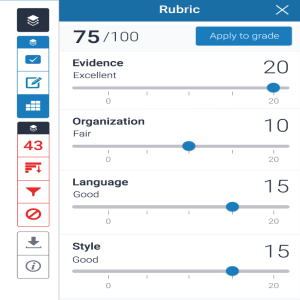

Providing students with timely, high-quality feedback is a worthwhile challenge that educators encounter every day. Turnitin is deeply invested in creating solutions that improve the feedback experience for both students and teachers. So, how can Turnitin's products come to the feedback rescue? Rubrics.
Rubrics bring clarity to the feedback and grading process. They can be used to evaluate student work according to defined criteria and scales. There are three types of rubricsOpens in a new tab/window educators can use in Feedback Studio:
-
Standard rubrics have pre-determined criteria but allow instructors to define the scale values and criteria percentages.
-
Qualitative rubrics are rubrics with no numeric scoring values.
-
Custom rubrics are—no surprise here— fully customizable. From criteria to scale values, instructors and administrators can fill them is as they please.
With endless rubric possibilities at an educator's fingertips, here are three reasons why rubrics should be leveraged in the feedback process:
-
Rubrics can help to calibrate grading across teachers and schoolsOpens in a new tab/window. A rubric can be used to create shared definitions of proficiency. When faculty all learn to use a rubric in the same way, it makes the student evaluation process more consistent and efficient and promotes horizontal and vertical alignment across departments and districts.
-
Speaking of shared definitions of proficiency, rubrics also clarify the criteria for excellence for studentsOpens in a new tab/window. When students understand what is expected of them and reflect on their own work with these expectations in mind, they develop metacognitive skills and feel ownership over their progress.
-
Huzzah! Feedback Studio's writing rubrics just got an upgradeOpens in a new tab/window. Revision Assistant's genre-specific rubrics, aligned with 6th - 12th grade Common Core standards, are now available in Feedback Studio to help middle and high school students tackle argumentative, narrative, informative, and analytical writing.