



Table of contents
- 1. What is Turnitin’s Learning Integrity Report?
- 2. What trends are discussed in Turnitin’s Q2 Learning Integrity Insights Report?
- 3. What are the key findings of Turnitin’s Q2 Learning Integrity Insights Report?
- 4. How many students use AI in the UK?
- 5. How does student AI use in the US compare to the UK and Australia?
- 6. Is AI usage higher among higher education or secondary (K-12) students?
- 7. At what stage of the writing process are students most likely to interact with an AI chat?
- 8. Who is in charge of AI solutions on campus?
- 9. Why are off-the-shelf generative AI tools failing to meet the needs of educators?
- 10. What are multipart/scaffolded assignments, and why do they support learning integrity?
- The bottom line
Turnitin's Q2 2026 Learning Integrity Insights Report is now live. The report analyzes real student submissions across the US, UK, and Australia, and nearly 83,000 AI chat prompts to address the big questions weighing on educators right now.
Specifically, just how many students are using AI for their assessments? How does usage differ depending on region and age group? And who, exactly, is in charge of AI implementation within educational institutions?
The numbers give a rare insight into the intersection between AI and learning, and how educators can navigate these uncharted waters. Below, we’ve extracted the key takeaways from the report and structured the insights using your most commonly asked questions.
Alternatively, download the full Turnitin Q2 Learning Integrity Insights Report PDF.
In this blog:
- What is Turnitin’s Q2 Learning Integrity Report?
- What trends are discussed in Turnitin’s Q2 Learning Integrity Insights Report?
- What are the key findings of Turnitin’s Q2 Learning Integrity Insights Report?
- How many students use AI in the UK?
- How does student AI use in the US compare to the UK and Australia?
- Is AI usage higher among higher education or secondary (K-12) students?
- At what stage of the writing process are students most likely to interact with an AI chat?
- Who is in charge of AI solutions on campus?
- Why are off-the-shelf generative AI tools failing to meet the needs of educators?
- What are multipart/scaffolded assignments, and why do they support learning integrity?
1. What is Turnitin’s Learning Integrity Report?
Turnitin's Learning Integrity Insights Report is a digital publication from Turnitin that analyzes internal data to report on how students across the US, UK, and Australia use AI in their writing, and how educators are responding.
The report contains both quantitative trends and qualitative insights from conversations and focus groups. Quantitative findings are drawn from global student submissions processed by Turnitin’s AI writing tools. Qualitative data was compiled from conversations with educators and administrators, including participants from more than 60 global education events, virtual webinars, and roundtables held throughout 2026.
This report is the second installment in the series. You can download the Turnitin Q1 Learning Integrity Insights Report via the Turnitin website.
2. What trends are discussed in Turnitin’s Q2 Learning Integrity Insights Report?
In the Q2 report, you can expect:
- Regional and grade-level differences in student AI writing use.
- What students are asking AI to do during the writing process, based on Turnitin Clarity chat data.
- Why educators need education-specific AI tools dedicated to supporting learning.
- The shift in institutional AI governance, with faculty and teaching leaders, not IT, driving AI strategy.
3. What are the key findings of Turnitin’s Q2 Learning Integrity Insights Report?
The report reveals several critical trends in AI usage and education strategy. Namely:
- US higher education students are offloading their writing to AI (>80% AI writing detected) at double the rate of their fellow students in the UK and Australia.
- Students primarily engage with Turnitin’s AI assistant during the active drafting stage to develop content and seek feedback on assignment rubrics.
- Faculty and teaching leaders, rather than IT departments or administrators, are primarily responsible for driving institutional AI strategy and implementation.
- Educators are increasingly demanding education-specific AI tools that offer transparency, assignment-level customization, and support for scaffolded writing workflows, rather than generic off-the-shelf solutions.
4. How many students use AI in the UK?
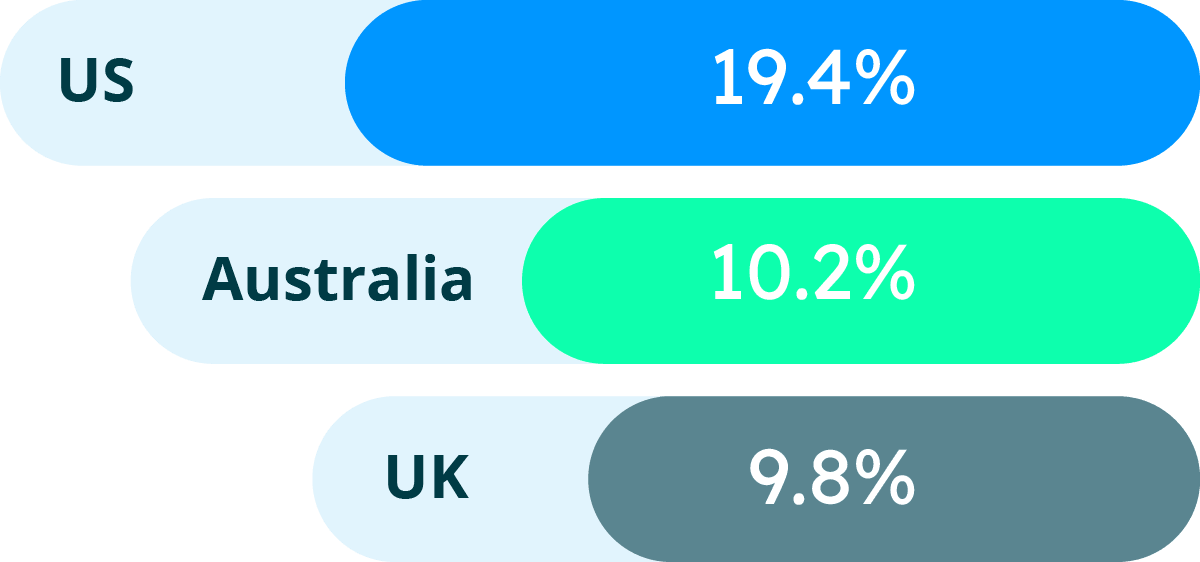
1Analysis of total submissions to Turnitin’s AI writing detection tools from October 2025 through April 2026 from the US, UK, and Australia higher education institutions only. In the US, 33 million submissions. In the UK, 2.1 million submissions. In Australia, 3.1 million submissions.
In UK higher education, around half of all submissions show at least some AI use (>0% AI writing detected). When it comes to ‘heavy reliance’ - submissions where more than 80% of the writing is AI-generated - that figure sits at 9.8%.
At the K-12 level, the UK actually leads the US and Australia for breadth of AI use, with 40% of submissions showing at least some AI present.
But heavy reliance stays low at the secondary level, with just 5-6% of submissions scoring above 80% AI writing.
5. How does student AI use in the US compare to the UK and Australia?
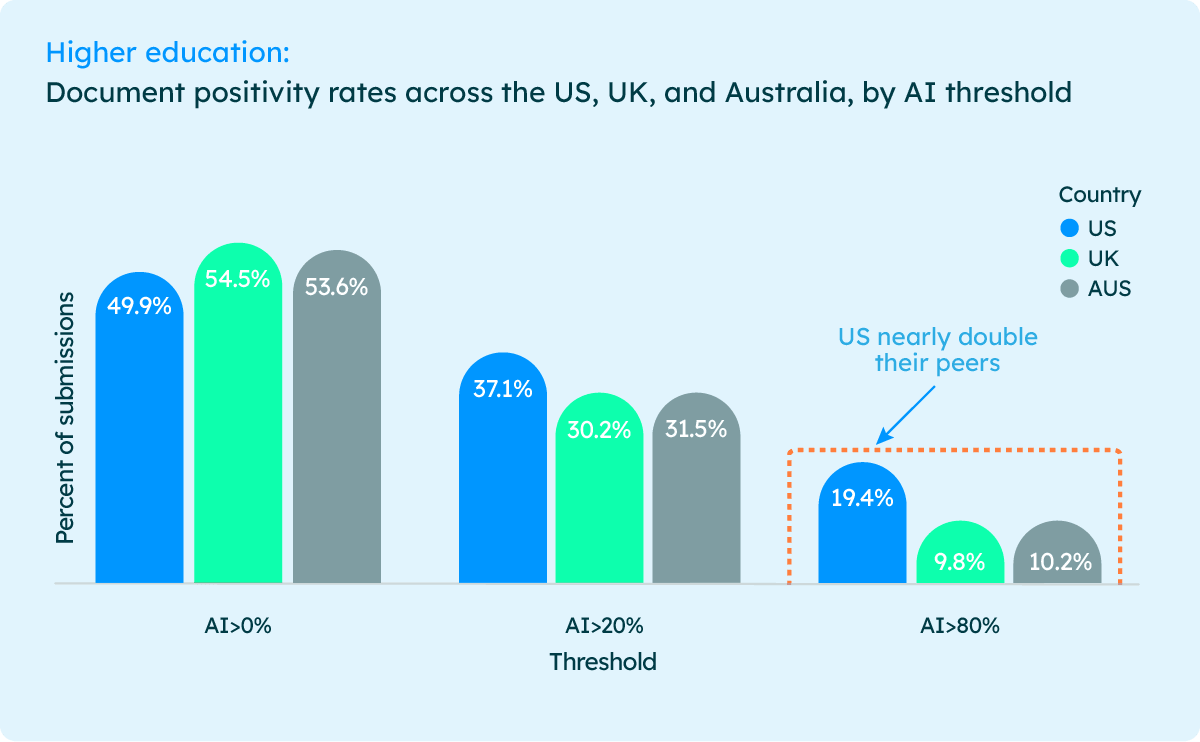
2Turnitin’s AI indicator does not report AI writing less than 20%. Our testing has found that there is a higher incidence of false positives when the percentage is between 0 and 19. In order to reduce the likelihood of misinterpretation, our AI indicator will display an asterisk (*) for percentages between 0 and 20 to call attention to the fact that the score is less reliable.
3 Analysis of total submissions to Turnitin’s AI writing detection tools from October 2025 through April 2026 from the US, UK, and Australia higher education institutions only. In the US, 33 million submissions. In the UK, 2.1 million submissions. In Australia, 3.1 million submissions.
4 Analysis of total submissions to Turnitin’s AI writing detection tools from October 2025 through April 2026 from the US, UK, and Australia K-12 institutions only. In the US, 3.5 million submissions. In the UK, 780,000 submissions. In Australia, 703,000 submissions.
When looking at submissions with >80% AI writing scores for higher education students, the US has nearly double (19.4%) the number of submissions compared to the UK (9.8%) and Australia (10.2%). In all three countries, about half of higher education submissions have at least some AI present (>0%).
6. Is AI usage higher among higher education or secondary (K-12) students?
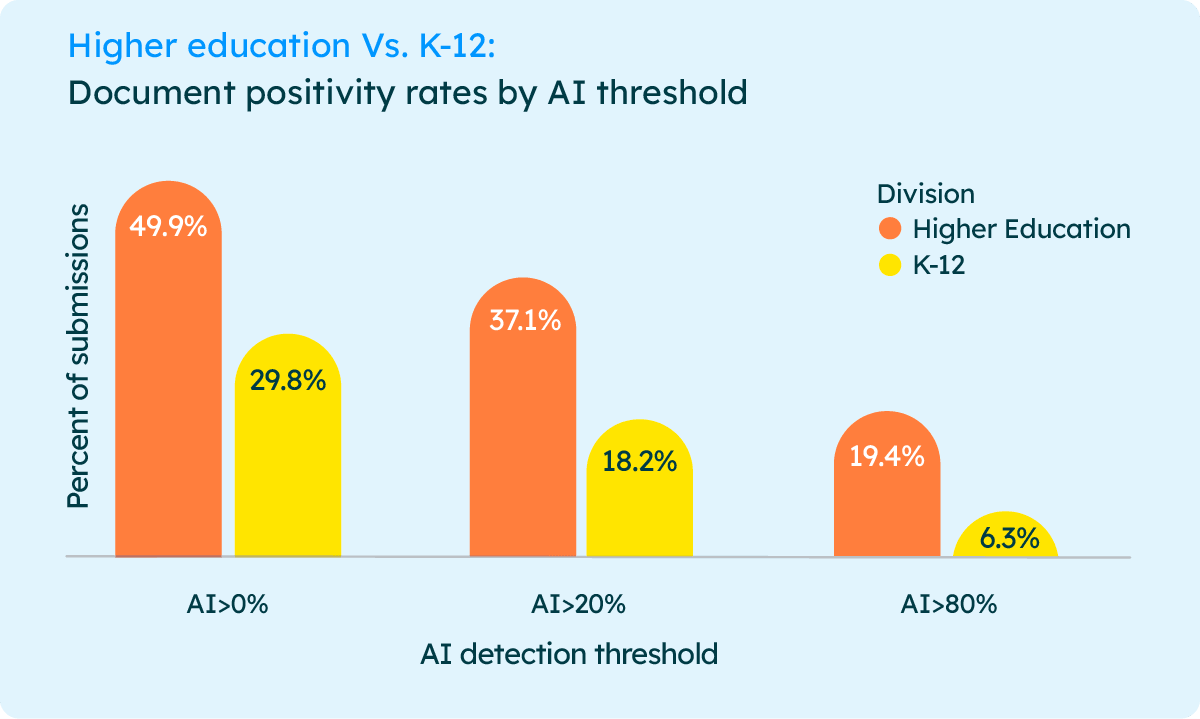
K-12 submissions from all three countries show only 5-6% of submissions with >80% AI
writing, which is about half (UK and Australia) or a quarter (US) of higher education
submissions. The biggest difference is in the percentage of papers with at least some AI
writing present, with the UK leading at 40%, and the US and Australia around 30%.
7. At what stage of the writing process are students most likely to interact with an AI chat?
When it comes to AI in the writing process, students are most likely to interact with Turnitin’s AI assistant during the active drafting stage.
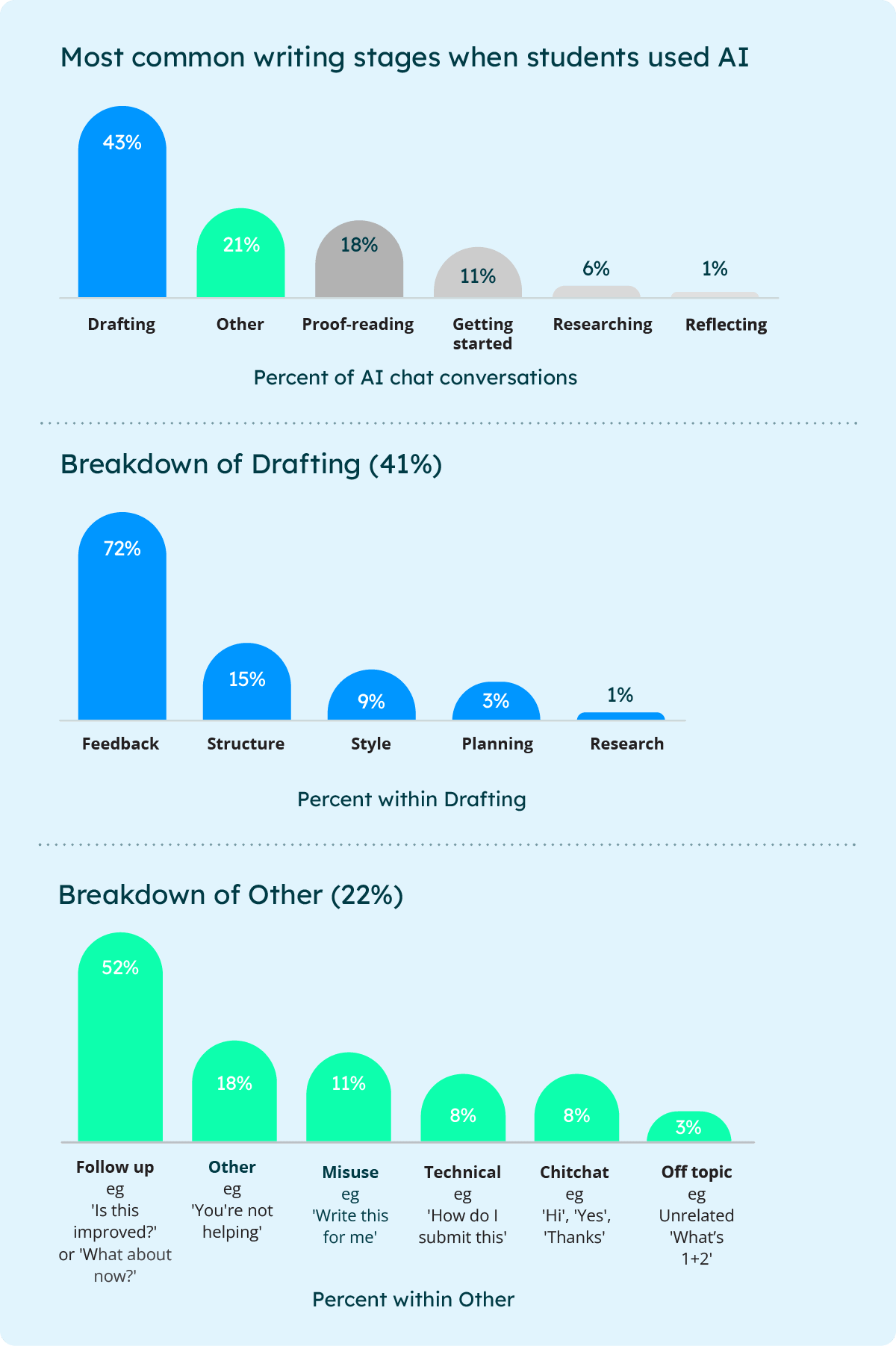
An analysis of approximately 83,000 student prompts inside Turnitin Clarity revealed that most interactions occur when students develop the content of their paper and seek feedback on whether they are aligned with assignment rubrics.
8. Who is in charge of AI solutions on campus?

8 Approximately 83,000 prompts inputted into Turnitin Clarity's AI chat were analyzed from a two-month period spanning 19 February 2026 through 20 April 2026.
Faculty and teaching and learning leaders are at the forefront of institutional AI execution, not tech leaders or administrators. Turnitin webinar polling data indicates that 48% of teaching and learning leaders are primarily responsible for implementing AI tools at their institutions, outpacing IT leadership (17%) and cross-functional committees (16%).
9. Why are off-the-shelf generative AI tools failing to meet the needs of educators?
Commercial, generic AI tools do not account for the human element of grading and the nuances of student development. Educators do not want punitive tech; instead, they are asking for education-specific AI tools centered on three pillars: transparency into how a student writes, assignment-level customization that aligns with a specific grading rubric, and workflows that scaffold the writing journey sequentially.
10. What are multipart/scaffolded assignments, and why do they support learning integrity?
Multipart assignments transform standalone assessments into a connected, scaffolded experience built for student growth and learning integrity. Instructors gain the flexibility to link assignments into structured checkpoints throughout the writing process, supporting iterative work that builds over time, embeds formative feedback at every stage, and guides students from first draft to final submission within a single, cohesive workflow.
6 Results from 160 participants polled on, “Which roles/departments are primarily responsible for implementing AI-related tools and solutions at your institution?” during an April 23, 2026 webinar entitled, “Does Detection Matter? Integrating AI with Authentic Learning”.
The bottom line
The data is clear: secondary students are using AI, more higher education students are using it, and use is heaviest in the US amongst higher education students. But students aren't just using AI to offload the entire essay writing process. Rather, they're using it to draft, refine, and check their progress.
However, there is a tension at the heart of all of this. While students have raced ahead in terms of their AI use, many institutions are scrambling to keep up. HEPI's survey found that while nearly all UK students use AI to support their studies, only 36% feel encouraged by their institution to do so, and just 38% say they're actually provided with AI tools.
Data points like this can be used to structure conversations around how AI is managed in your institution. There is an opportunity for educators and institutions to foster meaningful learning that works with AI, not against it.