


Academic integrity is increasingly a global issue. Institutions connect beyond national boundaries, sharing research and resources. Students, too, often study in different countries, and enter a job marketplace that requires global communication. Furthermore, as we move through a post-industrial world, ideas become critical work currency.
It’s important, then, to support academic integrityOpens in a new tab/window and transcend language barriers so we can foster original thinking and original ideas throughout the world, no matter where the learning is taking place.
What are some inclusive approaches to academic integrity?
- Globally aligned terminology is a step towards a shared understanding of academic integrityOpens in a new tab/window and values. Likewise, instructors who clearly define academic integrity within their classroom ensure that students understand exactly what constitutes academic misconduct. Providing this scaffolding is a first inclusive step.
- Explicit instruction can mitigate inadvertent misconduct. Providing explicit instruction promotes engaging and belongingOpens in a new tab/window and helps students new to the academic integrity framework. For example, providing clear definitions of individual versus group work can prevent student collusion. When students understand that, for instance, work that will be evaluated individually shouldn’t be done as group work, they understand these lines more clearly.
- Frequent formative assessments support classrooms with a mastery-orientation, or practice to gain competence (Lang, 2013Opens in a new tab/window). According to Lang, “If the student really wants to learn and master the material, cheating will not help them do so.” Additionally, feedback loops not only support students in their learning journeyOpens in a new tab/window and help them feel seen, they bring learning insights to teachers.
- Assessments that accurately measure learning. When assessments are designed so that students see them as opportunitiesOpens in a new tab/window to demonstrate and extend their learning, students feel a partnership with instructors and course material and are less apt to cheat. Doing so bridges the gap between teaching and learning.
- Cultural differences affect approaches to academic integrity. Academic integrity principles are based on Western culture. According to Fishman, “American ideals that place emphasis on individual responsibility have led to practices such as honor codes and pledgesOpens in a new tab/window” (2015Opens in a new tab/window). What defines respect in one culture may be otherwise in another. In some cultures, mimicry is a great form of respectOpens in a new tab/window, even if under the ideals of Western academic integrity, without attribution it plays out as plagiarism. Having a contextual understanding of student starting points helps support students in their journey.
It is important to note that culture transcends race and countries of origin; culture is made up of many components of identity, including age and generation. Even the phrase “individual responsibility” has evolved over time in North America to encompass its opposite, from a duty to others to “everyone for themselves” (Aeon, 2021Opens in a new tab/window)—which then affects communication of values across age groups. So it’s important to keep in mind all components of cultural differences.
Finally, utilize tools that support an inclusive approach towards academic integrity.
Turnitin’s growing database of content in each language not only helps support more students and teachers, it ensures that academic integrity is globally inclusive and aligned. Turnitin’ s software identifies student submissions and published content in 176 languages ensuring better plagiarism checking for Non-English content. And for Turnitin Feedback Studio and Originality Check customers, can compare submissions for more than 40 languages, producing translation similarity reports in both English and the submitted language.
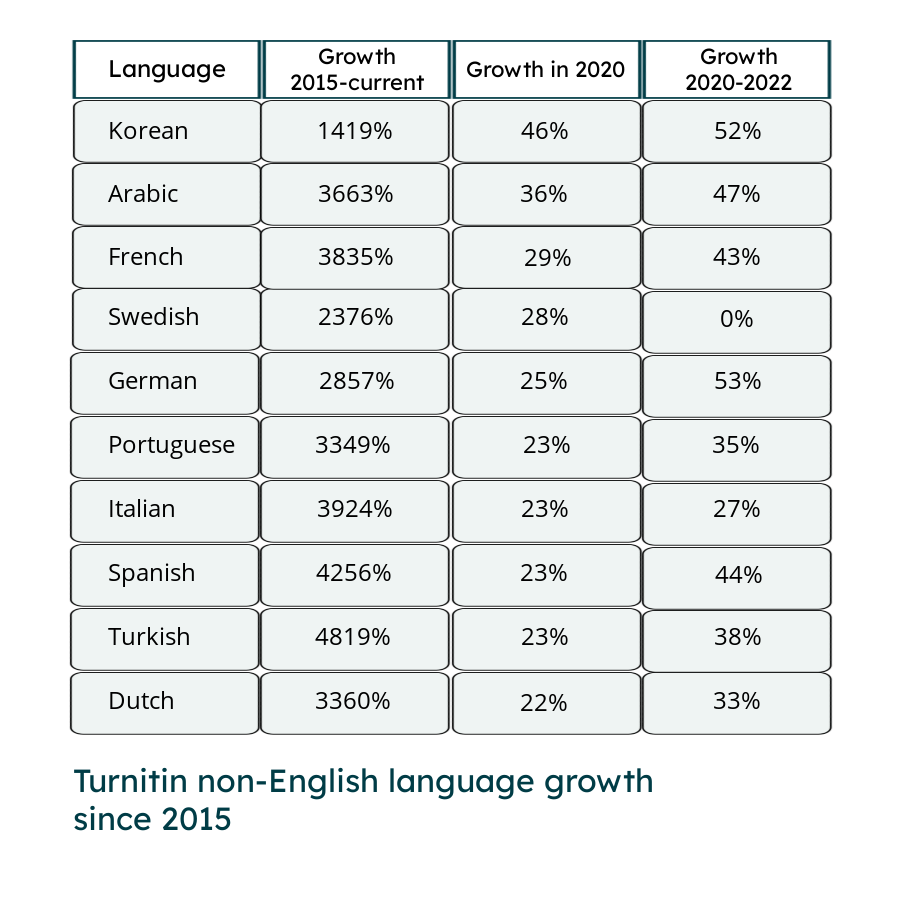
Non-English use of Turnitin has greatly increased in recent years, signifying a global shift towards prioritizing academic integrity. The languages that have experienced exponential growth are Korean, Arabic, French, German, Spanish, and Russian. We anticipate more language adoption over time. This new expansion in language detection allows us to identify lesser-used languages and understand how to support students and teachers globally.
“Cheating,” states Lang, “is an inappropriate response to a learning environment that’s not working for the student” (Lang, 2013Opens in a new tab/window). The responsibility is clear in this statement; students must know what constitutes cheating, and that it is wrong. Additionally, instructors who fortify their curriculum and teaching to make students feel seen and supported, uphold academic integrity.
As instructors, we can make clear to students what academic misconduct is, and thereby facilitate understanding that cheating is an inappropriate response. By doing so, we raise awareness and build an inclusive culture of academic integrityOpens in a new tab/window within classrooms. As well, we can create a sense of belonging for studentsOpens in a new tab/window within our learning community. We can provide assessments that align to what is taught and that measure learning accurately. Thus, we ensure that assessments are meaningful learning opportunities. We can provide scaffolding with frequent, formative assessments with feedback loops that uphold student-teacher communication. We can help students feel seenOpens in a new tab/window and thereby mitigate opportunities for misconduct. And there are fewer ways for Turnitin to promote inclusion than to include as many languages as possible within our products.